
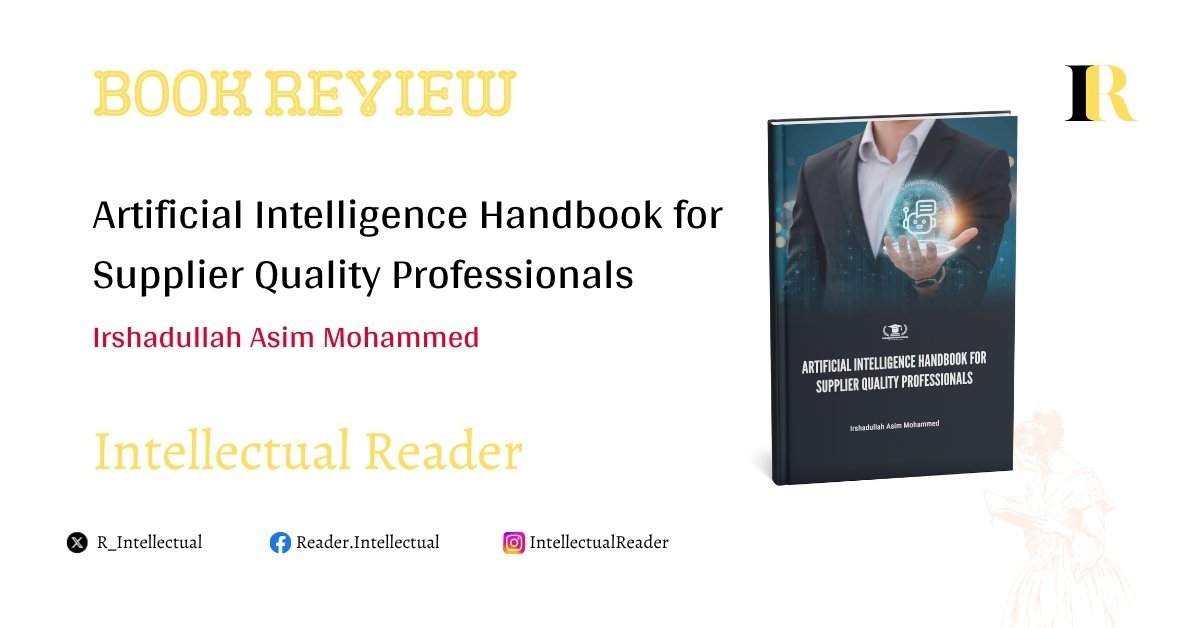
Irshadullah Asim Mohammed’s Artificial Intelligence Handbook for Supplier Quality Professionals (2021) stands as a landmark publication in the emerging confluence of artificial intelligence (AI) and supplier quality management (SQM). The book is a comprehensive and methodically structured guide that not only interprets the language of technology for industry professionals but also redefines the future contours of quality management through AI-driven transformation. It distinguishes itself through its intellectual clarity, meticulous organisation, and a rare balance between theoretical depth and practical applicability. In a field often marked by fragmented insights and surface-level discussions, Mohammed’s handbook is both an academic resource and a practitioner’s manual, offering a holistic framework for understanding and implementing AI in supplier quality systems.
The book is organised into sixteen well-sequenced chapters divided across four major sections, each of which progressively expands the reader’s comprehension of the subject. The first part, Fundamentals and Overview, establishes the conceptual groundwork. Here, Mohammed provides lucid explanations of AI’s basic constructs, such as machine learning (ML), natural language processing (NLP), and computer vision, before introducing their industrial relevance. The distinction between narrow and general AI is addressed with notable clarity, helping readers understand why practical applications today are often narrow in scope yet immensely impactful in function. The chapter on the fundamentals of AI introduces deep learning and the ethical dimensions of algorithmic operations, demonstrating that the author’s approach is not merely technical but also reflective.
In the following chapter on Supplier Quality Management, Mohammed delineates SQM as a strategic and process-driven function that ensures supplier reliability, consistency, and compliance. What makes this section especially valuable is the integration of AI concepts into traditional SQM frameworks, showing readers that the two domains are not mutually exclusive but naturally complementary. By grounding technological innovation in the realities of supplier selection, evaluation, and risk management, the author prevents AI from appearing as a distant abstraction. The clarity with which he explains core processes such as supplier audits, certifications, performance metrics, and risk mitigation tools reflects both professional expertise and pedagogical discipline.
The second part, The Intersection and Core AI Applications, constitutes the heart of the book. It demonstrates the transformative potential of AI within SQM and explores the technologies reshaping supplier evaluation, collaboration, and monitoring. The chapters on AI’s intersection with supplier quality, machine learning applications, and predictive analytics offer one of the most complete explorations of this interdisciplinary field available in current literature. For instance, Chapter 4’s detailed account of machine learning in supplier quality illustrates how algorithms can analyse vast data sets to forecast supplier reliability, detect anomalies in production, and predict quality deviations before they escalate. Such discussions move beyond theoretical optimism to demonstrate how AI systems can materially improve decision-making and operational efficiency.
Particularly impressive is the treatment of predictive analytics and NLP. The chapter on predictive analytics and risk management (Chapter 6) provides a sophisticated discussion of how predictive models simulate supply chain scenarios and forecast disruptions. Mohammed’s handling of this subject demonstrates a deep understanding of statistical inference and machine learning without alienating readers who may lack advanced mathematical training. The chapter on NLP (Chapter 7) bridges technology and communication by illustrating how NLP tools can be applied to analyse supplier communications, detect sentiment, and monitor contractual compliance. By including such applications, the book underscores the multi-dimensional nature of AI in supplier relations, showing that automation can extend beyond data analysis to the realm of interpretation and collaboration.
The third section, Implementation, Ethics, and Case Studies, distinguishes this handbook from other works in the genre. Most books on AI and quality management either remain confined to technological exposition or offer superficial implementation advice. Mohammed transcends both tendencies by providing a structured and empirically informed discussion on integrating AI within existing organisational frameworks. In Chapter 8, he outlines a detailed roadmap for AI adoption, beginning with readiness assessment, data preparation, and strategic alignment. The clarity of his approach ensures that the text can serve as a real-world implementation guide rather than a mere conceptual overview.
The subsequent chapter on overcoming implementation challenges addresses issues frequently neglected by AI literature: data inconsistency, employee resistance, and supplier hesitation. The author’s insistence on communication, collaboration, and transparency as enablers of technological change demonstrates his human-centric understanding of AI. Instead of treating resistance as a technical barrier, he interprets it as a behavioural and organisational challenge requiring thoughtful management. Such insights make the book valuable not only to engineers and data scientists but also to executives, policymakers, and human resource professionals involved in digital transformation.
Among the most intellectually stimulating sections are those devoted to ethics and regulatory compliance. Chapter 11, Ethics of AI in Quality Management, is particularly notable for its sophisticated engagement with fairness, transparency, and accountability. Mohammed’s exploration of bias mitigation, explainability, and responsible AI practices ensures that the reader appreciates the moral complexity underlying algorithmic decision-making. His inclusion of explainable AI (XAI) as a tool for fostering stakeholder trust reflects an advanced awareness of contemporary AI debates. Chapter 12 extends this ethical discussion into the legal realm, analysing compliance with global regulations such as the General Data Protection Regulation (GDPR) and the California Consumer Privacy Act (CCPA). By elaborating on cross-jurisdictional challenges and data minimisation principles, the author demonstrates a lawyerly precision that is rarely found in technical handbooks.
The chapters that follow, on AI success stories and real-world challenges, offer compelling evidence of the book’s empirical grounding. Through case studies of companies like Toyota, IBM, and General Electric, Mohammed illustrates how AI transforms supplier relationships, enhances monitoring, and enables predictive risk assessment. These cases are not presented as promotional success stories but as analytical studies, highlighting both achievements and pitfalls. Chapter 14, which discusses common causes of AI project failures, further enhances the credibility of the text. By acknowledging problems such as data quality issues, integration complexity, and insufficient strategic clarity, the author creates a balanced and trustworthy narrative. This willingness to confront limitations distinguishes the handbook from works that celebrate AI uncritically.
The final section, Future Outlook, brings together the preceding analyses into a forward-looking synthesis. Chapter 15, Emerging Trends in AI and Supplier Quality, explores how technologies like blockchain and IoT will merge with AI to create transparent, traceable, and self-regulating supply ecosystems. The discussion of collaborative AI systems points towards a future where human judgment and machine precision operate in synchrony rather than opposition. The final chapter, Preparing for the Future, functions as both a summary and a strategic guide. It emphasises skill development, adaptability, and continuous improvement, encouraging professionals to evolve alongside technology rather than merely adopt it. The call for upskilling in data literacy, analytics, and compliance underscores the author’s awareness that technological success depends on human capability.
In evaluating the book’s distinctiveness, it is important to note how it departs from the conventional structure of AI or quality management texts. Most existing books tend to privilege one domain over the other. Technical texts on AI often overlook managerial realities, while quality management manuals usually treat AI as an ancillary tool rather than a transformative framework. Mohammed avoids both extremes by synthesising technological sophistication with managerial pragmatism. His methodology is integrative, combining conceptual explanation with case-based learning, ethical reasoning, and forward-looking insight. This multidimensionality makes the book stand out within its genre.
Another distinguishing feature is the author’s accessible yet authoritative prose. While the subject matter is complex, the writing remains remarkably clear. Technical terms are defined before being used in analysis, and a practical illustration follows every conceptual exposition. The pedagogical structure mirrors academic rigour but remains aligned with professional readability. The chapters are logically interconnected, each concluding with insights that prepare the reader for the next stage of understanding. This coherence ensures that the book can be used for both sequential study and selective reference, a flexibility that enhances its practical utility.
The inclusion of ethical and regulatory considerations further broadens the book’s significance. In an era when AI applications are frequently criticised for opacity and bias, Mohammed’s insistence on fairness and accountability is commendable. His discussion extends beyond compliance checklists to a philosophical reflection on human responsibility in technological decision-making. The emphasis on explainability, transparency, and human oversight positions the handbook within the global discourse on trustworthy AI. For supplier quality professionals, who operate in industries where accountability and traceability are paramount, such ethical grounding is invaluable.
From a professional perspective, the book’s greatest strength lies in its applicability. Each chapter contributes to the development of a complete AI integration framework that professionals can directly employ. For instance, the sections on machine learning models, NLP-based supplier communication analysis, and predictive risk management are detailed enough to inform project design and implementation. The inclusion of readiness assessments, implementation roadmaps, and lessons learned from real-world failures makes the handbook not only informative but also operationally helpful. This practicality distinguishes it from works that remain confined to theoretical exposition.
Academically, the handbook’s merit lies in its conceptual comprehensiveness. It covers a wide range of topics, from AI fundamentals and ethics to predictive modelling and governance, without compromising depth. For researchers and students, the text provides a rich foundation for further study in AI’s industrial applications. Its balanced treatment of both opportunities and challenges makes it a credible academic source, suitable for courses in quality engineering, industrial management, and technology ethics.
The book’s value for the target audience, supplier quality professionals, is therefore multidimensional. It equips them with the vocabulary and analytical tools needed to navigate the ongoing digital transformation of their field. It helps them understand not only what AI can do but also how it should be implemented, monitored, and governed. The discussions on collaboration and transparency are particularly relevant in a post-pandemic world where global supply chains are increasingly decentralised and risk-prone. Mohammed’s insistence on ethical integration ensures that readers learn to balance innovation with integrity. For professionals at different stages of their careers, whether novices seeking to understand AI fundamentals or senior managers responsible for strategic implementation, the book offers insights appropriate to every level of expertise.
In comparing Mohammed’s handbook with other works in related genres, one notices its unusual comprehensiveness and ethical foresight. Whereas many AI-focused management texts concentrate primarily on efficiency metrics and data strategies, this book expands the conversation to include human, legal, and philosophical dimensions. It reminds readers that supplier quality management is not merely about statistical accuracy but about trust, collaboration, and long-term sustainability. The inclusion of case studies alongside cautionary discussions of failed implementations provides a rare equilibrium between optimism and realism. This balance makes the book uniquely reliable, allowing readers to form nuanced expectations about AI adoption.
In conclusion, Artificial Intelligence Handbook for Supplier Quality Professionals is a meticulously researched, intellectually rigorous, and eminently practical guide that redefines the relationship between technology and quality management. Irshadullah Asim Mohammed brings a remarkable depth of understanding to both fields, and his synthesis of AI and SQM principles is executed with scholarly precision and managerial sensibility. The book’s structured progression, from fundamentals to future readiness, ensures that it functions both as an introductory manual and as an advanced reference. Its ethical vision, clarity of exposition, and real-world applicability make it a rare contribution to both industrial practice and academic scholarship. For supplier quality professionals seeking to thrive in an era of rapid digital transformation, this handbook is not merely recommended reading—it is indispensable.
Get the latest edition from Amazon India – click here.
Review by Ajit Kumar for Intellectual Reader