
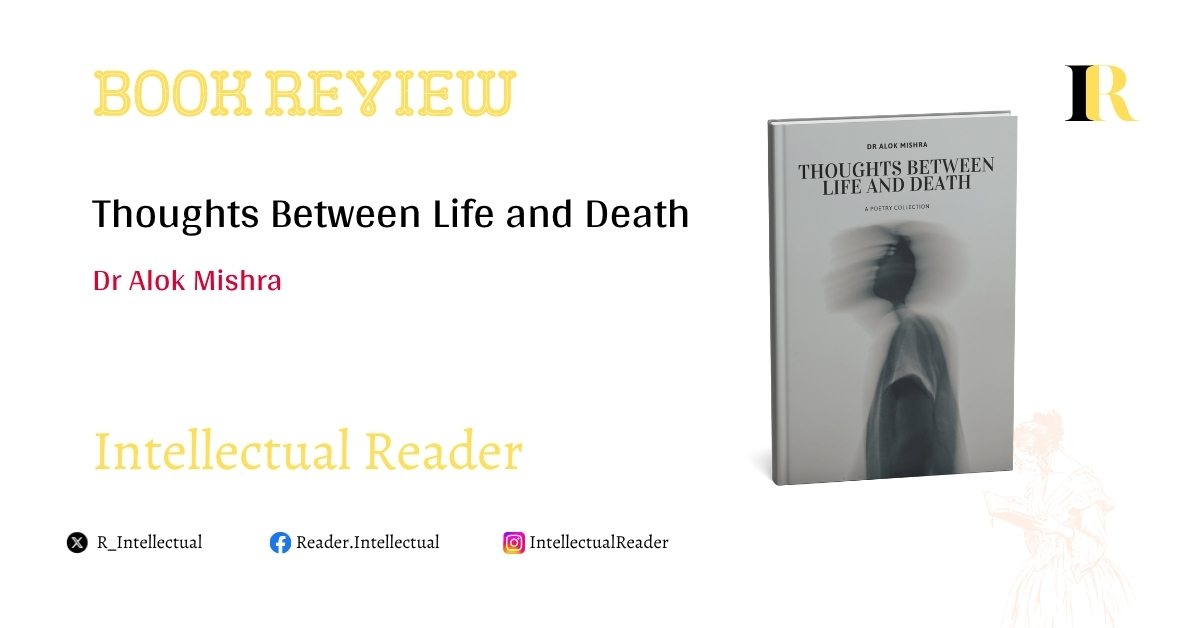
In Thoughts Between Life and Death, Dr Alok Mishra presents a poetic collection that moves beyond mere personal expression into deeper meditations on existence, loss, renewal, art, and meaning. The title itself signals the liminal territory that the poems inhabit: not the calm of life nor the finality of death, but the space between—where questions persist and insights quietly emerge. Mishra’s strengths lie in the clarity of his language, his willingness to engage with philosophical themes without becoming obscure, and his use of vivid, programmatic imagery to ground these themes. These qualities position him within the evolving field of Indian English poetry, which has increasingly embraced a fusion of inward reflection and outward breadth.
One of the opening poems, We two parted?, captures the paradox of closeness and separation with arresting simplicity:
“When we two parted,
there was no agony
in either
of the two
who
lived all our lives together,
so close and near,
and so, so dear
one could hardly guess
one from the other.”
Here Mishra challenges the expected pain of separation, he emphasises a union so deep that even the act of parting registers no agony. In doing so he shifts the focus from dramatic rupture to subtle detachment, suggesting that real intimacy may transcend conflict. In the tradition of Indian English poets such as Kamala Das or A. K. Ramanujan, both of whom explored the personal and relational, Dr Mishra keeps the interpersonal dimension, yet his stance is more contemplative, less confessional. The poem signals his aspiration to examine relationships not merely as emotional terrain but as metaphysical condition.
Another poem, The Garden and Its Shadow, explores the interplay of splendour and downfall through a metaphor of a garden. Mishra writes:
“The garden of grandeur and glory
casts its shadow
long.
It pervades the senses of visitors
with fragrance and beauty
on display for everyone to see
at the cost of one’s
pleasure and agony.”
In this poem he uses the metaphor of the garden to reflect on how beauty, spectacle, and decay co-exist. The “shadow” becomes as important as the “grandeur and glory,” highlighting that part of what we admire also contains cost—pleasure intertwined with agony. The sustained use of natural imagery situates Mishra in the tradition of Indian poets who draw upon the landscape and the seasons as vehicles of meaning. Yet his tone remains detached and quietly philosophical, emphasising observation over sentimentality.
Mishra’s engagement with artistic creation and the conditions of art appears in The Art and the Artist, where he writes:
“Poetic justice
is a flawed concept we long for.
Suitable for the human art,
it’s more of a tool to lure the arche architect
away from the divine mathematics, perfect and immaculate.”
Here he interrogates the notion of justice through the lens of creativity, suggesting that human art aims for “poetic justice” but the universe itself follows a different “rulebook.” The poem questions the assumption that art can capture or enforce moral balance. Within Indian English poetic discourse, which often addresses social critique or personal trauma, Mishra takes a different route: he reflects on art, justice and cosmic order. He thus brings into dialogue not only personal emotional experience but philosophical reflection on form, creativity, and the nature of the universe.
Mortality and transformation also occupy centre stage. In the poem Unexpected he writes:
“The very darkness that drowned me deep
unfolded unto me
the eternal source of light,
unaffected by the glimmer outside,
pure, serene, and calm,
coming from very much inside me;
the freedom that illuminated my soul
shook hands with my terrain of thoughts
and became my friend
in the darkness
that lured me deep
to help
me find the light.”
This extract illustrates how Mishra treats darkness not simply as absence, but as prelude to illumination. The inner “terrain of thoughts” becomes the site of transformation—not external revelation. The poem draws on spiritual tradition, yet remains firmly rooted in the lyric moment. In Indian English poetry, poets such as Jayanta Mahapatra and Eunice de Souza have engaged with inner consciousness and existential longing; Mishra aligns with them, yet his focus on the interplay of darkness and inner light gives his voice a distinctive spiritual-philosophical flavour.
Finally, the poem And Regret treats knowledge, burden and the self-conscious loop of knowing:
“Only if I knew
that knowing it would bring
a burden I could seldom carry
and ferry among those I know,
only to be rejected.
Who knows
what I know?
Do I know
if they know?
Who knows
all those who know?”
Here Mishra uses repetition of “knows” to reflect on epistemic uncertainty, the weight of knowledge, and isolation. The circular structure echoes the poem’s theme: knowing leads to burden, burden to rejection, rejection to silence. This aligns with contemporary Indian English poetry’s concern with subjectivity, alienation, and the limits of language—but Mishra’s tilt is toward philosophical enquiry rather than social commentary.
Across the collection, three interlinked features stand out: the liminal space between binaries (life/death, darkness/light, knowledge/ignorance), the economy of language, and persistent imagery grounded in nature or creative metaphor. Mishra avoids overt flamboyance; his lines are measured, accessible, often deceptively plain, yet richly suggestive. This approach places him in a middle path between the more experimental flights of some contemporary poets and the more traditionally lyrical ones.
Within the broader perspective of contemporary Indian English poetry, Mishra occupies a niche of contemplative, philosophically-oriented verse. Indian English poetry, from the early days of Toru Dutt and Sarojini Naidu, moved through Nissim Ezekiel’s urban realism, Kamala Das’s confessional intensity, Mahapatra’s meditative existentialism, to the more plural and experimental voices of the 21st century. Mishra does not reject this lineage; rather he draws from it and reorients it: he retains urban awareness and personal introspection, yet his frame is consciously philosophical and universal. His use of metaphors of nature, time, art and solitude connects with older traditions, while his inner-landscape focus and liminality speak to the concerns of the present century—identity, mortality, and transcendence.
The collection also signals that Indian English poetry is not limited to identity politics, post-colonial critique or socio-cultural description. While those remain vital, Mishra reminds us that the “between-space” of life and death, or of wisdom and ignorance, remains fertile poetic terrain. He thereby broadens the scope of what Indian English poetry can engage with. The voice is Indian in sensibility—references to nature, solitude, meditation, cycle of time—but universal in reach. This unity of rootedness and universality is one of the collection’s strengths.
Critically, the book does have areas where deeper variation or formal risk might enhance its impact. Some poems remain strongly contemplative and slightly reluctant to experiment with form or voice. Readers who prefer the avant-garde or radical formal play might feel the collection’s restraint as mild. Yet that very measure is arguably the collection’s virtue. Mishra seems to argue that contemplation demands calm, not agitation; that poetry’s task is to evoke rather than agitate. In that sense, the collection offers a quiet but sustained invitation to reflection, rather than dramatic aesthetic shocks.
One of the more remarkable aspects of the collection is how it engages creative self-reflexively. Poems such as The Art and the Artist and Heartbreak question not only the (poetic) subject but the act of creation itself:
“No heartbreak can make a poet!
Poetry doesn’t stem from a broken heart
which fell apart
merely because someone left
and left a few marks to be felt, dealt with and smelt
with emptiness and shallowness
of the breast.”
Here Mishra repudiates the romantic cliché that poets write only from wounds. He argues that poetry is “creating flowers in the desert, oceans on Neptune, and even Gods alive!” He thereby elevates poetry to the realm of imaginative creation rather than mere response to pain. This meta-poetic dimension adds to the collection’s sophistication and places Mishra in the tradition of poets who think about the nature of poetry itself—another way he contributes to the broader canon.
In sum, Thoughts Between Life and Death is a work of quiet power. Alok Mishra crafts poems that humble rather than overwhelm, that invite rather than assert. His thematic concerns, love, solitude, memory, mortality, art, knowledge, are timeless, yet he treats them with freshness and personal clarity. The extracts quoted above illustrate his ability to speak with economy yet depth, to move from image to insight without theatricality. Within Indian English poetry, he offers both continuity and innovation: continuity because he remains true to the poetic impulse of introspection, metaphor, nature, and spirituality; innovation because he explores liminality, knowledge burden, and the act of creation with contemporary awareness.
For readers of Indian English poetry, whether academic, casual, or spiritual seeker, this collection is a meaningful addition. It invites slow reading, re-reading, and reflection. It reminds us that between life and death lies a fertile poetic territory where being and becoming conjoin. In this sense the book is more than a set of poems: it is a meditative journey, a philosophy in verse, and a testament to Alok Mishra’s evolving craft.
..
Get a copy from Amazon India now – click here!
Review by Priya for Intellectual Reader
..
Thoughts Between Life and Death by Dr Alok Mishra, a detailed review of the poetry collection
- Intellectual Reader's Score
Summary
A must-read collection of poems from a poet who continues to contemplate… without a pause in the production from his creative oven!