
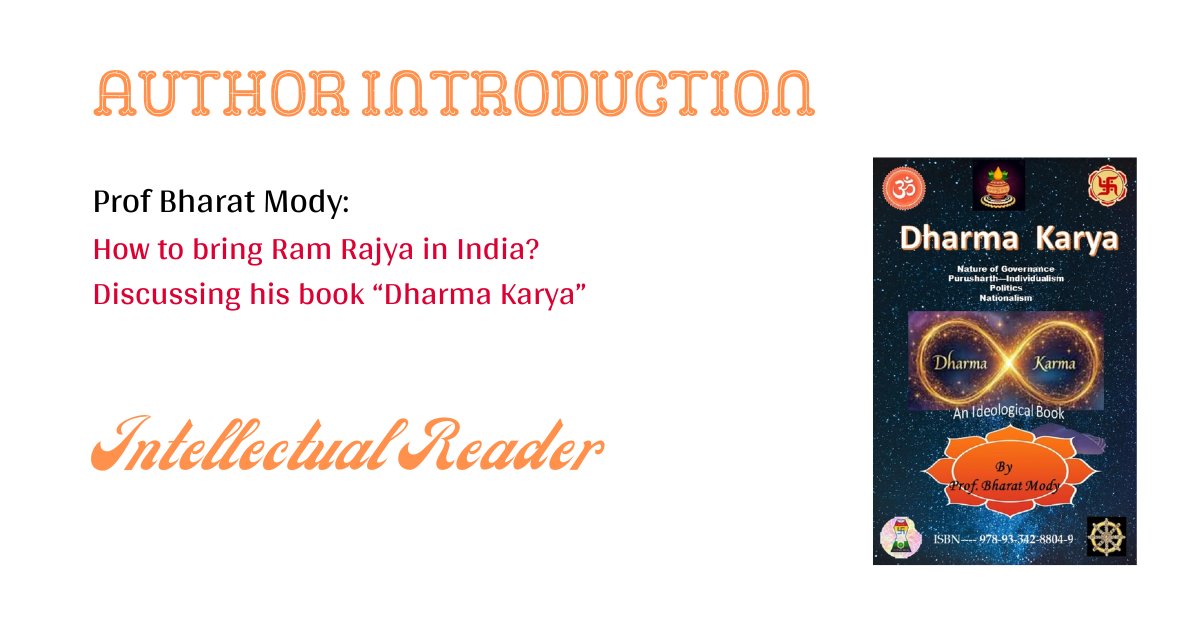
Ancient Wisdom for a Sustainable World: Prof. Bharat M. Mody’s Vision in DHARMA KARYA
In the twenty-first century, the discourse on sustainability has often been dominated by Western frameworks, including scientific climate models, international agreements, technological innovations, and economic reconfigurations. Yet within Bharat’s intellectual landscape, a growing body of thought seeks to anchor sustainability in the subcontinent’s indigenous knowledge systems. Prof. Bharat M. Mody’s Dharma Karya: An Ideological Book is one such work that boldly claims the answers to modern crises lie not in external imitations, but in the philosophical, cultural, and ethical frameworks of Sanatan Dharma.
Mody argues that the world is trapped in an ideological decline, led astray by flawed governance models, exploitative economics, and a loss of moral compass. His proposed corrective is not merely a patchwork of reforms but a civilisational reorientation rooted in the principles of Sanatan Dharma. This reorientation, he claims, has the potential to simultaneously transform Bharat’s internal crises and contribute to a global sustainable order. The book situates ancient Indian methods—whether in education, healthcare, governance, or economics—as practical pathways to sustainability, arguing that these are not relics of the past but enduring models adaptable to the challenges of the present and the future.
Sanatan Dharma as the Civilisational Core
At the heart of Mody’s vision is the assertion that Sanatan Dharma is not a religion but a way of life. Unlike faith-based systems that often prioritise dogma, he insists that Sanatan Dharma is scientific, culture-rich, artistic, non-binding, and oriented towards harmony. For Mody, its sustainability lies in its resilience: despite centuries of invasions, colonialism, and ideological challenges, Sanatan Dharma has survived by adapting while remaining rooted in timeless principles.
He contrasts this with other world civilisations—such as the Mayan, Greek, Roman, and Communist experiments—that collapsed due to their obsession with power, materialism, or rigid ideological systems. Sanatan Dharma, by contrast, thrives on its inclusivity, adaptability, and eternal values, which are naturally aligned with sustainability. In his analysis, sustainability is not merely environmental or economic but holistic, encompassing the ethical, social, political, and spiritual dimensions of life.
Prof Mody, no doubt, is right in his vision and the intellectual information he shares. Sanatana Dharma, in its original form, has sustained forever, along with timely re-evaluations and recalibrations. And it can very well form the core of the growth model that the author proposes, as historical and archival evidence says so.
Education: The Gurukul Model for Holistic Growth
One of the central areas where Prof. Mody reclaims ancient wisdom for sustainable development is education. He identifies the colonial legacy of Macaulay’s education system as one of the most significant barriers to sustainable societal growth in Bharat. According to him, the system has created generations of job-seekers and bureaucratic clerks rather than self-reliant innovators, philosophers, and socially responsible individuals.
Mody proposes a return to the Vedic Gurukul model, which emphasised not only literacy but also the holistic development of an individual’s mind, body, and spirit. The Gurukul system integrated philosophy, metaphysics, epistemology, ethics, and aesthetics with practical skills such as agriculture, astronomy, medicine, and governance. It sought to cultivate independent thinkers grounded in Dharma, capable of balancing self-interest with social responsibility.
Such a model, Mody contends, is inherently sustainable because it equips individuals with value-based knowledge rather than just employability. In an era where education often fuels consumerism and alienation from culture, the Gurukul ethos provides a framework for cultivating self-reliant, ethical, and ecologically aware citizens, essential for sustainable societies.
Healthcare: Ayurveda as Preventive and Individualised Care
Healthcare is another domain where Mody situates ancient Indian methods as vital for sustainability. Modern healthcare, in his critique, is reductionist, specialist-driven, and overly dependent on the pharmaceutical industry, which treats symptoms rather than root causes. This model, although technologically advanced, has created unsustainable systems characterised by high costs, chronic illnesses, and a neglect of preventive measures.
In contrast, he promotes Ayurveda as a civilisationally rooted, holistic, and sustainable approach to health. Ayurveda, grounded in the understanding of Prakriti (individual constitution), emphasises balance, prevention, and lifestyle alignment with natural rhythms. It is a system that views health as a harmony between the body, mind, and environment, rather than the absence of disease.
By foregrounding Ayurveda, Mody offers not only a critique of modern medicine but also a practical model for sustainable healthcare—one that reduces dependency on industrial systems, lowers costs, and aligns individuals with a natural way of living. He envisions a health system where personal responsibility, preventive care, and lifestyle discipline are central, thereby easing the burden on healthcare infrastructure while fostering healthier societies.
Governance: Philosophical Foundations for Justice
A striking feature of DHARMA KARYA is its insistence that philosophy must form the bedrock of governance. Mody argues that India’s democracy’s greatest failure has been the absence of a philosophical foundation. The Constitution, in his view, borrowed heavily from colonial frameworks, ignoring Bharat’s own intellectual traditions.
To correct this, he advances the idea of Political Objectivism, which he adapts from Ayn Rand’s Objectivism but reinterprets through the lens of Purusharth (the fourfold human pursuits of Dharma, Karma, Kama, and Arth). This model promotes reason, individualism, self-interest, proactive capitalism, and non-violence as the guiding pillars of governance.
For Mody, this alignment of governance with philosophy ensures sustainability by preventing it from degenerating into mere populism or power struggles. Instead, it creates a just, benevolent, and scientific world community. His ultimate goal—Ram Rajya—is envisioned as a political order founded on mutual trust between the state and its citizens, rooted in Dharma rather than coercion. Such a governance model, he claims, is both historically rooted and sustainable in the future.
Economics: Laissez-Faire Capitalism with Ethical Anchors
Mody’s advocacy of Laissez-Faire Capitalism is perhaps one of the most controversial yet intriguing aspects of his sustainability vision. In an era when global capitalism is frequently criticised for exacerbating inequality and environmental degradation, Mody distinguishes between exploitative capitalism and ethical capitalism, rooted in Purusharth.
He argues that capitalism, when truly free and aligned with Dharma, is a moral system because it is based on voluntary exchange, individual responsibility, and the creation of value. By contrast, socialism and communism, which redistribute wealth from creators to non-creators, are labelled as destructive and unsustainable.
His model holds that economic inequality is natural and stems from differences in individual ability and in the value they create. What matters is not economic equality but political equality, where every citizen has equal opportunity under a Dharma-based legal and political system. In this view, sustainable economics emerges not from enforced redistribution but from fostering individual productivity, ethical wealth creation, and societal responsibility.
Cultural Sustainability: Identity, Language, and Arts
Mody also situates sustainability in cultural terms. He critiques the adoption of the term “India,” seeing it as a colonial imposition, and insists on the civilisationally resonant term “Bharat.” For him, the reclamation of cultural identity is central to sustainability because a society alienated from its roots cannot chart a stable future.
This reclamation extends to arts, literature, and philosophy. Sanatan Dharma, he argues, is artistic, ideologically rich, and culture-driven, capable of sustaining creativity and knowledge production without succumbing to ideological rigidity. In this respect, cultural sustainability becomes as essential as environmental or economic sustainability, ensuring that Bharat’s future development remains anchored in its civilisational essence.
Controversial Proposals and Their Sustainability Claims
No profile of Mody’s sustainability vision would be complete without acknowledging his more controversial proposals, particularly those related to citizenship and political restructuring. He calls for a reclassification of citizens into “Citizens of India” (naturally born Hindus with voting rights) and “Indian Citizens” (others, including Muslims, permitted residency and economic rights but denied political participation). He frames this as a necessary “ethnic cleansing” to safeguard Dharma and ensure civilisational survival.
While these proposals are deeply divisive and raise serious ethical questions, within Mody’s framework, they are presented as mechanisms of sustainability that ensure that Bharat’s governance and identity remain aligned with Sanatan Dharma. Critics may find these exclusionary, but they highlight his uncompromising belief that sustainability cannot be achieved without cultural and ideological clarity.
Writing Style as an Extension of Sustainability
Even Mody’s writing style reflects his sustainability ethos. His tone is polemical, assertive, and uncompromising, reflecting his conviction that half-measures cannot achieve the transformation he envisions. His didactic style—explaining philosophy, critiquing governance, prescribing reforms—mirrors the structure of ancient Indian texts that blended instruction with vision.
The very intensity of his rhetoric signals his urgency: for Mody, sustainability is not a gradual negotiation but a civilisational imperative requiring immediate, bold, and uncompromising action.
Conclusion
Prof. Bharat M. Mody’s DHARMA KARYA is not simply a critique of the present or a romanticisation of the past; it is an attempt to reconfigure the future through the wisdom of the past. His central argument—that Sanatan Dharma, with its integrated approach to philosophy, education, healthcare, governance, economics, and culture, provides the most sustainable framework for both Bharat and the world—is both radical and deeply rooted in civilisational pride.
By reclaiming the Gurukul model of education, the Ayurvedic system of healthcare, the Purusharth-based philosophy of governance, and ethical capitalism, he situates sustainability not as a Western import but as a civilisational inheritance of Bharat. His insistence on cultural identity, philosophical grounding, and ethical individualism reflects his conviction that true sustainability must be holistic, encompassing the moral, social, political, and ecological dimensions of life.
While many of his proposals, especially those related to citizenship and political restructuring, remain controversial and will continue to provoke intense debate, the larger contribution of his work lies in its audacity to imagine a world order guided by ancient Indian principles. In this sense, DHARMA KARYA positions itself as both a manifesto for Viksit Bharat and a blueprint for a sustainable global civilisation, demonstrating that ancient wisdom and modern aspirations are not mutually exclusive but potentially complementary paths toward a more enduring world order.
by Ashish for Intellectual Reader